Showing posts with label Component. Show all posts

Monday, October 17, 2011

What's the Difference Between HDMI Cable and Component Cables?

What's the Difference Between HDMI Cable and Component Cables?

Hdmi

Over a short length, the cables don't make a difference. What is different is that in the case of the component cables, the TV has to convert the component analog signal to digital. In the case of the HDMI cable, the signal is already digital. So there may be a perceptible difference if the TV doesn't do the conversion well.

Putting aside picture quality, the reason you should use the HDMI cable is that it carries the HDCP signals, component does not. If the source device, say a cable box, looks for the HDCP handshake, and doesn't get it, it Will not output an HD signal. So if you want to watch HBO in HD from a cable box, you have to use HDMI or DVI.

I use the component cables. Then again, I spent about on them (gold plated ends, large conductors, thick shielding, etc) for both the video components and audio channels. And, I bought them a few years ago, before HDMI cables were even around. The difference in performance between top-end component video cables and HDMI cables is negligent. But, if you just use standard RCA cables - like the cheap ones the cable TV company gives you - you won't get as good of quality as the HDMI cables.

As HDMI cable connections become more and more widely used, we are often asked: which is better, HDMI or component video? The answer, as it happens, is not cut-and-dried.

First, one note: everything said here is as applicable to DVI as to HDMI; DVI appears on fewer and fewer consumer electronic devices all the time, so isn't as often asked about, but DVI and HDMI are essentially the same as one another, image-quality-wise. The principal differences are that HDMI carries audio as well as video, and uses a different type of connector, but both use the same encoding scheme, and that's why a DVI source can be connected to an HDMI monitor, or vice versa, with a DVI/HDMI cable, with no intervening converter box.

The upshot of this article--in case you're not inclined to read all the details--is that it's very hard to predict whether an HDMI connection will produce a better or worse image than an analog component video connection. There will often be significant differences between the digital and the analog signals, but those differences are not inherent in the connection type and instead depend upon the characteristics of the source device (e.g., your DVD player) and the display device (e.g., your TV set). Why that is, however, requires a bit more discussion.

Several people a day are searching for an interconnection solution by trying to connect HDMI to Component outputs through a cable for their high-definition equipment. Unfortunately, this isn't a matter of rearranging wires and having the right type of connector. There is a fundamental analog versus digital incompatibility problem similar to the upcoming digital broadcast TV switchover versus your current rabbit ears that receive analog broadcast signals. They aren't compatible and leave people confused just like the poor fellow in the commercial.

Component video is based on an analog format. With analog signals, the voltage signal on the wire is in a wave format and how the wave changes in height is what is important. Theoretically it has an infinite number of values between zero and the maximum, somewhat like the variable windshield wipers I had on an old Thunderbird. With the HDMI or DVI format, these are based on digital signaling. Digital as you probably have heard, uses ones and zeros with a series of pulses all at the same height and they are either present or missing. At the other end, processing equipment reassembles the information. In a 4-bit binary coding, you can have 1 of 16 different values as 4 1's and 0's assembled as a group can have 16 different combinations. So equipment at the other end of the cable that is detecting signals and looking for analog sine waves would put out total gibberish if it just received pulses of 1's and 0's.

Some solutions are very easy. If an HDMI or DVI output is available on both boxes, use those. The difference between DVI and HDMI is that HDMI caries the audio in addition to the video signals. But DVI is just as good and other than the expense of an extra audio cable, that will solve your problem. If you were trying to use the Component outputs because you already had the HDMI port tied up, they make HDMI switch boxes that are fairly inexpensive where you can plug multiple HDMI cables in on one side with one output on the other.

Via component cables an analog signal is transfered. HDMI is digital. Among other things this has the following advantage: As long as the data is transferred correctly you have the perfect image data arriving at your TV. There won't be a single pixel difference in what the 'sending' device puts out and what reaches your TV. Component signals (as all analog signals) can vary in quality and you can get disturbances.

So actually: At first glance HDMI cables might appear more expensive than component cables, but that's not entirely true. For HDMI the requiered quality of the cable is related to the length you need. If you only need to cover a short distance (two or three meters) a cheap cable will give you the best possible result that could ever be achieved by any means ... it's digital ... the cheap cable has no influence on the image quality ... just like the network cable your computer uses to hook up to the inet has no influence on the image quality of videos you download / stream.

Of course this doesn't mean component is bad: Among affordable analog video connections it's probably by far the best, but HDMI just has the advantage of not having to care about the signal being unintentionally "affected" by outside influences during transfer. So if you can: HDMI is the better choice.

Oster 3212 Food Processor surge protector whole house

Wednesday, September 14, 2011

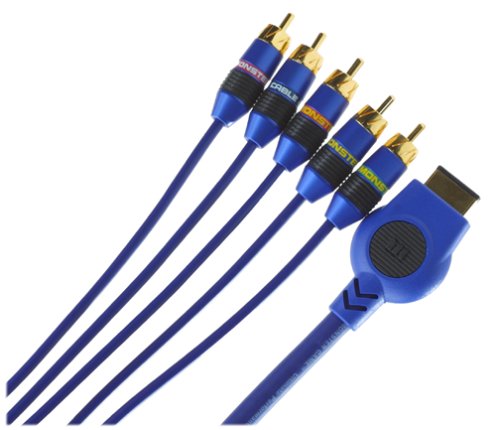
Monster PGL400 CVAA-10 Component Video with RCA Audio Cable Kit (10 feet)


Monster PGL400 CVAA-10 Component Video with RCA Audio Cable Kit (10 feet)


Rate This Product :


Monster PGL400 CVAA-10 Component Video with RCA Audio Cable Kit (10 feet)

Monster PGL400 CVAA-10 Component Video with RCA Audio Cable Kit (10 feet)
MODEL- MC126107 VENDOR- MONSTER CABLE PRODUCTS FEATURES- GameLink 400 Component Video with Analog Audio- 10 ft. Ultimate Performance Component Video/Analog/Audio Hookup of Sony Playstation 2 to TV or Receiver. The ultimate performance component video AV connection of PS2 to TVs or receivers with component video inputs. Nitrogen gas-injected dielectric insulator delivers maximum video signal strength for the clearest picture possible. 10 ft. extra-long length lets you play anywhere without controller extension cables. 5-in-1 cable design is simple to hook up and looks good too. 24k gold contact connectors ensure optimum video and audio signal transfer. Advanced DoubleHelix construction delivers reference quality sound for all your CDs and DVD movie titles.

Monster PGL400 CVAA-10 Component Video with RCA Audio Cable Kit (10 feet)

  • The ultimate performance component video A/V connection of PS2 to TVs or receivers with component video inputs.
  • 10 ft. extra-long length lets you play anywhere without controller extension cables.
  • 5-in-1 cable design is simple to hook up.
  • 24k gold contact connectors ensure optimum video and audio signal transfer.
  • Advanced DoubleHelix construction delivers reference quality sound for all your CDs and DVD movie titles.

Monster PGL400 CVAA-10 Component Video with RCA Audio Cable Kit (10 feet)

Available at Amazon : Check Price Now!


Monster PGL400 CVAA-10 Component Video with RCA Audio Cable Kit (10 feet)
*** Product Information and Prices Stored: Sep 14, 2011 23:18:42 ***

Vera Bradley Out To Lunch Bag

Monday, September 12, 2011

Lilliput 569gl-50np/ho/y 5" On-camera Hd LCD Field Monitor w/ Hdmi in Hdmi Out Component in Video in Video Out+hot Shoe Mount+du21 Battery+battery Charger


Lilliput 569gl-50np/ho/y 5" On-camera Hd LCD Field Monitor w/ Hdmi in Hdmi Out Component in Video in Video Out+hot Shoe Mount+du21 Battery+battery Charger


Rate This Product :


Lilliput 569gl-50np/ho/y 5

Lilliput 569gl-50np/ho/y 5
LILLIPUT 569HO 5" On-camera HD LCD field monitor w/ HDMI in HDMI out Component in Video in Video out569HO has HDMI out, HDMI in, Component in, Video in, Video out, Audio in.LILLIPUT 569H w/ 2 Battery plates: A & B.Compatible Battery Models Comments A SONY NP-F970, F550, F570, F770, F750. better have 2 units of batteries as a spare B Panasonic DU06/DU21/VBD140;SANYO DZhs301sw;Hitachi DZ-HS303SW/BZ-BP14S/DZ3200/BP07W,Fit following DV Models:Panasonic NV-GS/PV-GS/DZ-MV/GS/H28/H258/H288GK seriesDisplay ScreenButtonsF1, Mark: similar to "safe frame" of RUIGE TL-480HD, what you really get is the image in the White Mark Frame, but 569H only has 3 scales, TL-480HD has 5 scales.F2, underscan/overscan switch.F3, color mode: 6500k,7500k,9300k,red,green & blue,user-definable.F4, display ratio: switch between 4:3 and 16:9Panel Size5" TFT LCD monitor (Non-Touchscreen)LED BacklightYESAspect Ratio16:9Display Ratio16:9 or 4:3 adjustableImage FlipVertical flip and Horizontal flipInputs/OutputsHDMI inputSupports MAX 1080p ( 1920*1080p ) and 1080i( 1920*1080i)Compatible with Devices with HDMI or mini HDMI output such as Canon 5D mark II,Canon 7D,Nikon D300S and D3S and so on .HDMI output 1 HDMI out Component(YPbPr) inputSupports MAX 1080p ( 1920*1080p ) and 1080i( 1920*1080i) automatically compatible with PAL/NTSC video.Composite(AV) input1 video input and 1 audio input,Composite(Video out) 1 Video out ,Accessories Battery Mount Plate A 1pcs Battery Mount Plate B 1pcs Plastic Sunhood 1pcs 12V DC adapter 1pcs Manual 1pcsFree gift:mini hdmi cable and 1/4" hot shoe mount.The battery can last 7-9 hrs.

Lilliput 569gl-50np/ho/y 5

  • Screen Size: 5" (Diagonal)
  • 569HO has HDMI out, HDMI in, Component in, Video in, Video out, Audio in.
  • New Design of Plastic Sunshade & Button
  • 1/4" thread on the bottom
  • Resolution

Lilliput 569gl-50np/ho/y 5

Available at Amazon : Check Price Now!


Lilliput 569gl-50np/ho/y 5
*** Product Information and Prices Stored: Sep 13, 2011 04:47:14 ***

Bigelow Organic Green Tea K Cups Pizzelle And Waffle Maker justbeats headphones

Tuesday, July 12, 2011

Component to HDMI

Every day, consumers are looking for their network problems with trying to HDMI to Component outputs connected via a cable to connect to their HD fix installation. This is not simply a matter of reorganizing cable or unfortunately, with the right kind of plug. Essentially incompatible analog and digital, as the fast-approaching transition to digital television broadcasts from analog signals can be received by rabbit ears or a roof antenna. Why notcompatible amazed at the wind, people like the unfortunate person who sees in advertising.

Analog and digital signals are very different. Note that a similar component video signal is formatted. The voltage signal on the cable broadcast in a format to an analog signal, and the variations in wave height is the key. In theory, an analog signal is found values ​​between zero and infinity, as the windshield wipers on an old ThunderbirdVehicle.

Hdmi

In HDMI and DVI, but this is recorded in digital form. As you may already know, digital ones and zeros and a series of pulses at the same height, and are either there or not. The information is put together device processing at the other end. So any device that is expected from a wave analogue cable is the only ones and zeros interpreted as noise.

What alternatives are there for? HDMI or DVI output can be used if it is on bothBoxes. The only difference between DVI and HDMI is that HDMI carries video signals in addition to audio signals. DVI on the other hand, is just as good, but carries video and audio on separate lines in order to bear the cost of an additional audio cable. It makes a fairly inexpensive HDMI switch that has multiple HDMI cables if you tried to use the component outputs, because the HDMI port was already bound can attack.

When you hear that HDMI is superior toComponent cable, and want to convert HDMI Component would be to take a moment. There are numerous studies showing that HDMI cables are superior to the theory and digital format. This is because there is a lot of potential conversions between the various lines of resolution, before finally being displayed on your TV. For this reason, there are opportunities to predict the component connections, a better signal and picture. Above all, this is the case when starting the cable lengthover 25 meters. To determine the cable, which offers you the best looking image, each of the cables, if given the chance.

If you need to convert from Component to HDMI converter boxes are available but usually cost more than $ 200. However, if you go in the opposite direction, you can run into limitations when it comes to high definition content protection. This will prevent the possibility of view HDCP protected sources.

We hope that it is easy to solve with HDMIProblem with component HDMI or component cable solutions listed above. Otherwise, it gives you a chance to go in a large high-tech shopping spree.

Component to HDMI

mens luxury watch Tripod Heads

Tuesday, June 28, 2011

HDMI, DVI and Component Cables Explained

Skiing:

As the HDTV market continues to heat up, consumers are required, the cutting edge of technology designed to make smart purchasing decisions. There are a plethora of articles explaining the technical pros and cons of the three dominant HDTV display technologies namely: LCD, plasma and DLP. However, one major, but overlooked when choosing an HDTV set to the type of connection to high-definition video. The video connections available for HDTV are: componentVideo, DVI (Digital Video Interface) and HDMI (High Definition Multimedia Interface). We briefly the advantages and disadvantages of each.

Hdmi

Component video cable commonly referred to as R, G, B (red, green, blue) indicates it is actually composed of 3 separate cables because it distributes the three basic color components for display. All colors are weighted distribution of individual components red, green and blue are generated. Of the 3 HD connection technologies available today, analog componentThe video is a mature technology.

Advantage: Analog component video cable is mature and affordable.

-Disadvantage: component video cables are analog! All HDTV sets are inherently digital therefore extra digital to analog conversion and analog-to digital is necessary, necessary to process the video. This conversion can introduce video artifacts more. Since all HDTV is digital, it only makes sense to use a fully digital connection such as DVI or HDMI.

DVI (DigitalVideo Interface), as the name suggests, is an all-digital video connection. Unlike analog component cables the DVI interface transports the original digitized R, G, B video signals from HD source to HD display. Since it is digital, no artifacts or degradation will occur. You get exactly the image that provides the video source without degradation. DVI connection is often found on HDTV and PC graphics cards.

-Advantage: DVI is ALL-digital, so there is no imageDegradation from source to screen.

-Disadvantages: digitizing R, G, B requires extremely high-bandwidth. The aggregated data of the digital R, G, B signals 1.65 Gbps! The high bandwidth means that cable quality is important and also the link distance is limited. Typical link budget for a DVI is ~ 15 ft.

HDMI (High Definition Multimedia Interface) is the last state of the art video and audio connection. Technically, HDMI is identical to DVI with 3 notable differences. 1) HDMIa much smaller connector (it looks like a USB jack), 2) HDMI uses HDCP copy protection called (High Definition Copy Protection), and 3) HDMI digital audio transmission. HDMI, DVI, it is as all-digital therefore picture quality is "perfect" from source to screen.

-Advantage: HDMI is a digital video and audio connection. Only one cable is required for the transport of audio and video! This reduces cable clutter behind the theaterSetup.

-Disadvantage: Like DVI, the link is removed and a limited number of high-quality cable is necessary because the intrinsically high-bandwidth digital transport for the R, G, B the requested video.

Conclusion:

As the HDTV market continues to mature, consumers must be educated on the HDTV video connections available. We briefly the most important functions together with the advantages and disadvantages of each solution outlined connection, then the smart choice for consumers in the choice ofHDTV video connections.

HDMI, DVI and Component Cables Explained

vinyl wall art maxfli fire golf clubs ll bean messenger bag

Saturday, June 25, 2011

What is HDMI - Why is it better than 3 RCA Component, DVI and other video-cable

HDMI is a term that you encounter when buying a TV or a media player.

What is HDMI? How does it differ from other available standards? What does it mean for you? Let's go for it. HDMI (High Definition Multimedia Interface) is a licensable audio / connector interface for transmitting uncompressed video, encrypted digital streams. Hiitachi companies in consumer electronics, Matsushita, Philips, Silicon Image, Sony, Thomson and Toshiba, this standard is established and released beforeVersion 9 December 2002. This standard uses a single cable can carry digital HD video, multichannel audio and to bring some control signals. HDMI uses a carry only 15mm, 9-pin cable for both video and audio signals and a single remote for all devices in your home theater to operate. HDMI devices have intelligence Ginko? This helps to recognize TV resolution and automatic devices, so you do not have to worry about the choice of image format.

Hdmi

HDMI is an advanced and robustForm of DVI. And 'extensively developed to replace DVI and become the de facto standard for consumer electronics manufacturers. Uses HDCP (High-bandwidth Digital Content Protection) protocol, which protects the output against piracy and provides a secure connection between the source and sink. HDMI HDCP consensus helped associations of cable and satellite have HDCP required to prevent piracy. Although the latest version of HDMI is backwards compared to previous versionscompatible with earlier versions and with DVI devices.

Since the first version of HDMI in 2002, new features were added in each version. Even if all 1080pi video resolution support, they differ in their audio capabilities. Version 1.0 can decode most versions of audio contained in DVD and digital TV signals, including Dolby Digital and DTS. Version 1.1 adds support for DVD audio, users with compatible disks and players can listen to 5.1 channelAudio streams without the need to separate the six RCA audio cables. Version added 1.2/1.2a Super Audio CD (SACD) support the abolition of the need to iLink or analog cables need to listen to SACDs. The standard also includes support for Type A connector on the PC.

The last Version1.3b/1.3a/1.3b adds support for Dolby TrueHD and DTS-HD Master Audio, which are used in Blu-ray and HD DVD players. It supports a greater bandwidth of 10.2Gbps on the future demand for high-definition display devices. WithSupport for 30-bit color depth, 36-bit and 48-bit units of each color in nature with the entity that can perceive small details, like a human eye. Removes significantly stripes of color on the screen, for smooth tonal transitions and subtle gradations between colors. It synchronizes video and audio with greater accuracy so that you can experience crystal clear video and audio quality.

HDMI is now enhanced for easier integration with low voltage, AC coupled PC graphics controllers soBridging the gap between consumer electronics and PC World. Simple wiring, crystal clear audio / video, HDCP compliance and interoperability with PCs have HDMI set at the forefront of the connectivity standards and made it the de facto standard.

What is HDMI - Why is it better than 3 RCA Component, DVI and other video-cable

breville bbl600xl blender farberware coffee maker